Fort Near Wind Gap
. . . Fortunately its landlord, Mr. Seeple, had been brought up as a boy near the old Teed Blockhouse and was able to tell me its location, which was three miles south of his hotel, at Miller’s Station on the Bangor and Portland railroad. I immediately proceeded to the spot and made all necessary inquiries. . . .
This military station is variously called “Teet’s House,” “Deedt’s Block House,” “Tead’s Block House,” &c., at Wind Gap. The reader, by this time, is probably not surprised at the variety of phonetical spelling he has come across in our old records, and need not be told, what is evident, that this is the same name variously spelled. At our present time it is my privilege to have been acquainted with members of a family whose name is similar, They spell it “Teed,” which is probably correct. In the neighborhood of what was the original Teed property, still live many descendants of that pioneer, three of them having farms on the Ackermanville road from ½ to 2 miles distant, and another, Mrs. Amandus Ehler, about 55 years old, who is the eldest, residing about one mile beyond Stephen Heitzman’s house on the road to Nazareth. I am indebted to the latter especially for information. In the course of many years, however, the name has become slightly changed to “Teel.”
The original building was not a fort erected by the Government, but merely a blockhouse, the private residence of Mr. Teed, which ”’as occupied because it was then the only building standing near the position which it was desired to possess. This position was certainly an important one, commanding as it did the roads to and from the Wind Gap, the Forts at and near the present Stroudsburg, Easton and Nazareth. From the Wind Gap, proper, it was distant four miles, in a direction south slightly east, and from Woodley, the lower end of Wind Gap, some three miles. Its distance from Nazareth was six miles, and from Easton about twelve miles.
Will the reader pardon me if I call his attention to the fact that, in speaking of this station, it is called Teed’s Blockhouse “at Wind Gap.” We know that this was not actually the fact but that, as has been said, it stood four miles away from the real Gap. I desire to mention it as an added proof of what I have already written relative to the location of Fort Henry “at Tolihaio Gap.” It was the only way in which those of that time could understandingly refer to certain positions.
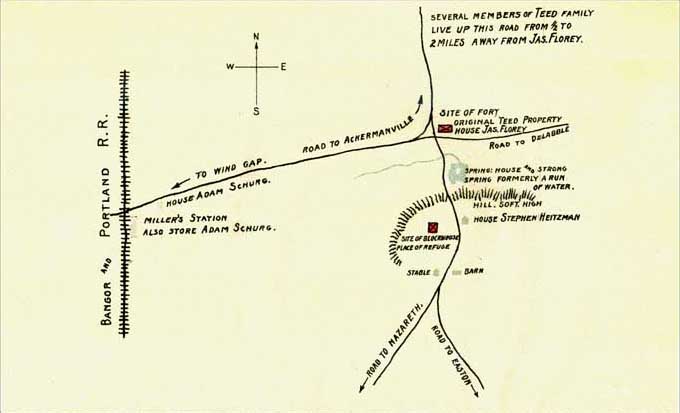
With this digression we return to our subject, and reach it at a time to introduce a part of the narrative which, for a while was a source of perplexity to me. Reference to the map shows the residence of Stephen Heitzman at the top of the elevation, near the spring house, distant from Jas. Florey’s house, and the site of Teed’s Blockhouse, about 75 yards south somewhat easterly, and from Miller’s Station, about 1/4 mile S. E. This farm is now the property of Mr. Heitzman, but was formerly the Ruth farm. A short distance across the road from it will be noticed the site of an old blockhouse, used as a place of refuge. Concerning this building I was able to get information even more readily than of the fort. Mrs. Ehler, previously named, was familiar with it, having been told of it by her father (a Teel), and other old residents. She was informed of its use as a blockhouse during the Indian War. Several interesting letters were received from Rev. Eli Keller, of Zionsville, Lehigh County, Pa., on this same subject. Its position on the hill gave it an excellent view of the country and, at first, I concluded it must be the fort for which I was searching. And yet the fact of its being on the hill is proof conclusive that such could not be the case, as we will see, later, that Teed’s Blockhouse stood on low, swampy ground. Then again the original Teed property, was on the other side of the spring, and it is doubtful whether he ever owned any part of the land on the elevation above the spring. Rev. Keller’s letters, which are most authentic and come from an unquestionable source, as will be seen in a moment, corroborate this, and give other valuable statements. The Fort near Wind Gap, or Teed’s Blockhouse, was certainly the home of Mr. Teed, probably the only building in the vicinity, and of course, on the original Teed property. All members of the family now living, with whom I spoke, told me this was where the house of Mr. Jas. Florey now stands and I have no hesitation in marking this as the site of our fort.
And yet the universal statement of those who should know is that a blockhouse stood on top of the hill, and I do not doubt the fact myself. I hardly think either, that the explanation of the matter is difficult, but will leave it to the reader to judge.
We know that this fort, so called, was merely a farm house, and, in 1756, its garrison was, at the most, but a handful of men. From this time until 1758 no further mention is made of it, the natural inference of which would be that it had been abandoned as a station. Indeed there is but little doubt of this, for we will soon see a petition from the inhabitants, in 1758, praying that the soldiers may be sent there, which was done. For a while all went well, when suddenly the blow fell from an arm which was always uplifted and ready to strike. The sufferer was Joseph Keller (great grandfather of Rev. Eli. Keller, my authority), who was settled in that neighborhood, having come to the country in 1737. On September 15th, 1757, his family was attacked by a band of Indians, his wife and two sons carried captives to Canada, and the oldest son, a lad of 14, killed and scalped in the attack.
Necessarily the neighbors were much alarmed, and felt that protection of some sort, for the future, was a thing requiring immediate attention. In the absence of troops at Teed’s House they decided to erect a blockhouse, as a place of refuge. Then it was that the building came into existence on the hill, and in it gathered all the people every night during the winter of 1757-58.
The distance from Mr. Dupui’s house on the Delaware river, as well as from Teed’s Blockhouse near Wind Gap, is given as 20 miles, and from the fort at Lehigh Gap as 8 miles. (Penn. Arch., vol. iii, p.339-340.) The building was probably, as its name indicates, a log house, but an exact knowledge of its character and appearance has passed out of the memory of the descendants of those who took part in the stirring events which we are relating. We do know, however, that, unlike most other places of defense, it was not surrounded by a stockade, but had connected with it two barracks for the accommodation of the garrison.


 Spearheaded by movie mogul Louis B. Mayer, the Academy was organized in May 1927 as a non-profit organization dedicated to the advancement and improvement of the film industry. . . .
 While catching up on old episodes of LIVE! with Regis and Kelly today, one of my staple shows going back to the early Kathie Lee days, Ripa showed a terrific illustration of herself drawn by a man who
 “Hellooo Uncle Leo.”
 AARON HILL’S NOTEBOOK